Client will get supported OAuth list from the tenant API, instead of
from injected env variables like `APPSMITH_OAUTH2_GOOGLE_CLIENT_ID`.

This is a step towards moving OAuth configuration out of env variables
completely, and into the backend database, so their configuration can be
tenant-wide, instead of instance-wide.
## Description

This PR upgrades Prettier to v2 + enforces TypeScript’s [`import
type`](https://www.typescriptlang.org/docs/handbook/release-notes/typescript-3-8.html#type-only-imports-and-export)
syntax where applicable. It’s submitted as a separate PR so we can merge
it easily.

As a part of this PR, we reformat the codebase heavily:
- add `import type` everywhere where it’s required, and
- re-format the code to account for Prettier 2’s breaking changes:
https://prettier.io/blog/2020/03/21/2.0.0.html#breaking-changes

This PR is submitted against `release` to make sure all new code by team
members will adhere to new formatting standards, and we’ll have fewer
conflicts when merging `bundle-optimizations` into `release`. (I’ll
merge `release` back into `bundle-optimizations` once this PR is
merged.)

### Why is this needed?

This PR is needed because, for the Lodash optimization from
7cbb12af88,
we need to use `import type`. Otherwise, `babel-plugin-lodash` complains
that `LoDashStatic` is not a lodash function.

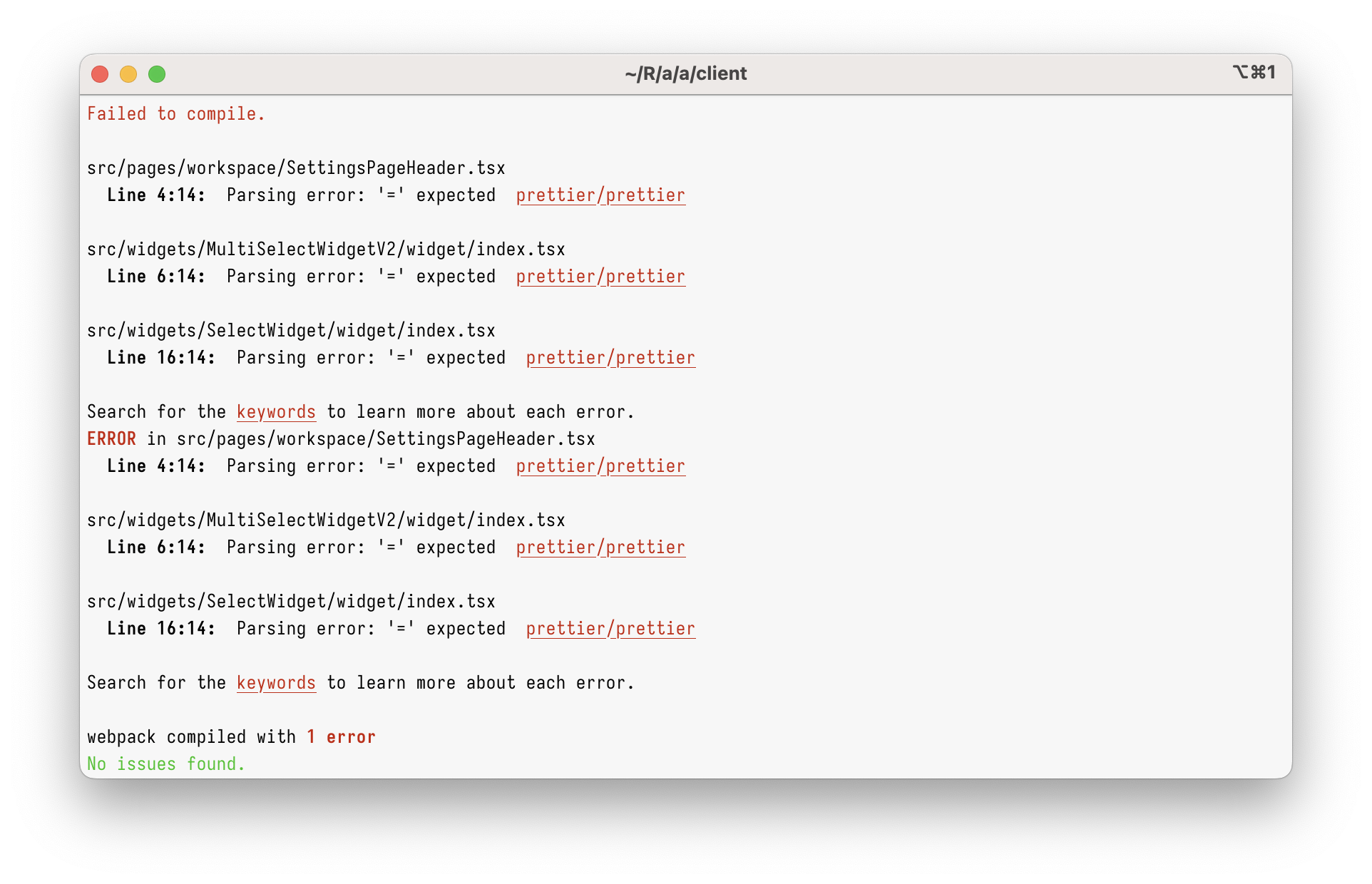
However, just using `import type` in the current codebase will give you
this:

<img width="962" alt="Screenshot 2023-03-08 at 17 45 59"
src="https://user-images.githubusercontent.com/2953267/223775744-407afa0c-e8b9-44a1-90f9-b879348da57f.png">

That’s because Prettier 1 can’t parse `import type` at all. To parse it,
we need to upgrade to Prettier 2.

### Why enforce `import type`?

Apart from just enabling `import type` support, this PR enforces
specifying `import type` everywhere it’s needed. (Developers will get
immediate TypeScript and ESLint errors when they forget to do so.)

I’m doing this because I believe `import type` improves DX and makes
refactorings easier.

Let’s say you had a few imports like below. Can you tell which of these
imports will increase the bundle size? (Tip: it’s not all of them!)

```ts
// app/client/src/workers/Linting/utils.ts
import { Position } from "codemirror";
import { LintError as JSHintError, LintOptions } from "jshint";
import { get, isEmpty, isNumber, keys, last, set } from "lodash";
```

It’s pretty hard, right?

What about now?

```ts
// app/client/src/workers/Linting/utils.ts
import type { Position } from "codemirror";
import type { LintError as JSHintError, LintOptions } from "jshint";
import { get, isEmpty, isNumber, keys, last, set } from "lodash";
```

Now, it’s clear that only `lodash` will be bundled.

This helps developers to see which imports are problematic, but it
_also_ helps with refactorings. Now, if you want to see where
`codemirror` is bundled, you can just grep for `import \{.*\} from
"codemirror"` – and you won’t get any type-only imports.

This also helps (some) bundlers. Upon transpiling, TypeScript erases
type-only imports completely. In some environment (not ours), this makes
the bundle smaller, as the bundler doesn’t need to bundle type-only
imports anymore.

## Type of change

- Chore (housekeeping or task changes that don't impact user perception)


## How Has This Been Tested?

This was tested to not break the build.

### Test Plan
> Add Testsmith test cases links that relate to this PR

### Issues raised during DP testing
> Link issues raised during DP testing for better visiblity and tracking
(copy link from comments dropped on this PR)


## Checklist:
### Dev activity
- [x] My code follows the style guidelines of this project
- [ ] I have performed a self-review of my own code
- [ ] I have commented my code, particularly in hard-to-understand areas
- [ ] I have made corresponding changes to the documentation
- [x] My changes generate no new warnings
- [ ] I have added tests that prove my fix is effective or that my
feature works
- [ ] New and existing unit tests pass locally with my changes
- [ ] PR is being merged under a feature flag


### QA activity:
- [ ] Test plan has been approved by relevant developers
- [ ] Test plan has been peer reviewed by QA
- [ ] Cypress test cases have been added and approved by either SDET or
manual QA
- [ ] Organized project review call with relevant stakeholders after
Round 1/2 of QA
- [ ] Added Test Plan Approved label after reveiwing all Cypress test

---------

Co-authored-by: Satish Gandham <hello@satishgandham.com>
Co-authored-by: Satish Gandham <satish.iitg@gmail.com>
Part of #11855.

Instead of getting the Google Maps API Key from runtime env variables,
we get it from the server, as part of the response of
`/api/v1/tenant/current`. This doesn't add a database call, just include
the env variable name in the response, so shouldn't have any performance
impact on the API.

On the client though, the Maps API key won't be available, until at
least the first call to `/tenant/current` is finished.

Also, first big PR in client code. 🙂

Edit: not `/me` anymore, but from `/tenant/current`.

---------

Co-authored-by: Pawan Kumar <pawan.stardust@gmail.com>
Co-authored-by: Aishwarya UR <aishwarya@appsmith.com>
## Description

This PR adds the string `Community` along with the Appsmith version. This will help users identify the type of instance that they are running.

## Type of change

- New feature (non-breaking change which adds functionality)

## How Has This Been Tested?

Manually

## Checklist:

- [ ] My code follows the style guidelines of this project
- [ ] I have performed a self-review of my own code
- [ ] I have commented my code, particularly in hard-to-understand areas
- [ ] I have made corresponding changes to the documentation
- [ ] My changes generate no new warnings
- [ ] I have added tests that prove my fix is effective or that my feature works
- [ ] New and existing unit tests pass locally with my changes
* Remove optimizely, as it isn't being used anymore from the frontend codebase

* Remove optimizely references form netlify config, vercel config, index.html, docker script, nginx templates and example .env file
* added config to support code split

* splitting config

* moved the window declaration in EE file as its dependency will be updated in EE

* CE: Splitting ApiConstants and SocialLogin constants

* CE: split login page

* CE: moved getSocialLoginButtonProps func to EE file as it's dependencies will be updated in EE

* added key icon

* CE: created a factory class to share social auths list

* Minor style fix for social btns

* Updated the third party auth styles

* updated jest config

* updated third party login registry class